


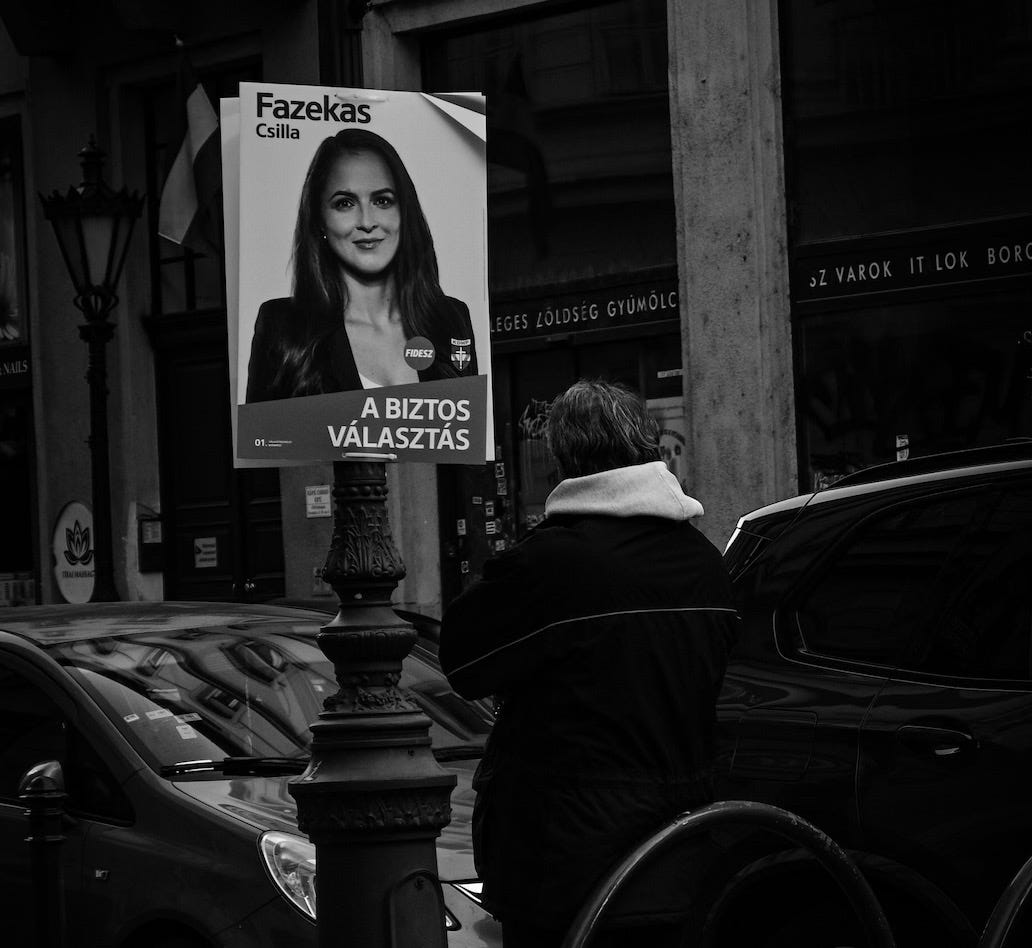
I arrived in Budapest the weekend after the election that ended Viktor Orbán’s sixteen-year grip on Hungary. On the streets of District VII, the Jewish Quarter, the posters were still up. Some had been ripped down. Some had been defaced. A few lay flat on the pavement, face-up, staring at the sky. Nobody had bothered to remove them.
That seemed about right.
I had not let myself believe it would happen. For months, the polling had shown Tisza ahead by margins that seemed too good to be true. I had watched the 2022 cycle, when United for Hungary went into election night with momentum and came out crushed. I knew what Hungarian electoral geography looked like, what Fidesz’s grip on rural constituencies meant, what a gerrymandered map could do to a popular vote. So I watched the supermajority projections with skepticism, and I waited for the catch.
There was no catch.
141 seats on 53.2% of the vote. Fidesz halved to 52. A turnout of 79.6% — the highest since the last Communist-era election of 1985. No contestation. Orbán conceded on the night. It was clean, decisive, and stunning.
Which made what I found on the ground all the more surprising.
“Megkönnyebbülés, nem igazi öröm”
Relief, not real joy. That was how a middle-aged woman put it, her children beside her, when I asked how she felt about the election. We were standing in HAB — Hungarian Art and Business, a contemporary art centre on Andrássy út. She said it simply, almost flatly, the way you say something that has been true for a while and doesn’t need explaining. Then she turned back to the exhibition.
I wasn’t sure what I was expecting, but it wasn’t that.
I flew into Budapest through Ferenc Liszt International Airport, the subject of an ongoing EU anti-fraud investigation — itself a lesson in what sixteen years of Orbán looks like. The structures Orbán built did not announce themselves. They were just there, quietly.
On the drive through Erzsébettelep, there was a billboard. On it: Dóra Dúró, a politician from Mi Hazánk (Our Homeland Movement) infamous for shredding a children’s book she deemed to be "homosexual propaganda" at a press conference. Her face was still there. Still up. The week after the election that was supposed to end all of this.
That felt like the right introduction to Hungary.
Budapest
The Jewish Quarter — the old ruin bar district, now colonised almost entirely by tourists — made it genuinely difficult to find Hungarians. The centre has become a theme park: beautiful but unkempt, full of stag parties and backpackers unaware an election just happened. Infrastructure that should have been upgraded wears its neglect visibly. Corruption, everyone agreed, had exploded under Fidesz. The money went somewhere. It did not go here.
One thing I had not expected: the visibility of LGBTQ people. Same-sex couples, visibly queer individuals, people presenting in ways that would have felt conspicuous elsewhere in Central Europe. Budapest has always been Hungary's liberal exception; this may simply be what it looks like when you pay attention. Whether people simply felt freer knowing Fidesz was out, I cannot say.
What I can say is that the legal picture has not changed and is unlikely to. Magyar's Tisza ran on a pro-European, anti-corruption platform — not a socially liberal one. LGBT adoption rights and same-sex marriage, constitutionally banned under Orbán, are not on his agenda. The law has not moved.
I met more Hungarians in Zugló and around Angyalföld. What I found was not jubilation. It was something quieter and more complicated: relief, caution, and often a frank admission that Tisza had not been anyone’s first choice so much as their only one. Several people described voting for Magyar the way many Americans described voting for Biden in 2020, not out of enthusiasm, but out of a desperate need for the alternative to lose.
Some younger Hungarians in District V were more vocal: openly contemptuous of Orbán, happy to say so to a foreign stranger. But even they were hesitant about Magyar. The celebrations, one told me, felt premature.
“We don’t really know what he is yet.”
The Vote Beneath the Vote
The headline obscures something. The only other party to cross the parliamentary threshold was Our Homeland Movement — the ultranationalist far-right. The liberal Democratic Coalition and the satirical MKKP won no seats. That the only genuine options facing Hungarian voters were centre-right, right, and far-right says something about where the country sits.
The voters who backed Tisza did not all back the same thing. An older couple I met from Balatonföldvár wanted more EU, yes, but also conservative values, Hungarian identity, nothing radical. They saw the result as a win-win. Others in Budapest voted purely to stop Fidesz. These are not the same electorate, and Magyar will have to govern both.
Analysts had noted before the election that Magyar leaned into some core continuities with Fidesz — nationalist rhetoric, scepticism about Ukraine’s EU accession, rejection of the EU migration pact. He is not Orbán. But he is not a liberal either.
The Same People
The most clarifying thing anyone said to me in Budapest came from a young Nigerian couple — medical students, five years in Hungary, who spoke with the authority of people who have watched the country from the outside in. When I mentioned the election result, one of them shrugged.
“These are the same people who kept him in for sixteen years.”
It landed like a correct answer to a question nobody had asked. Four elections which produced landslide mandates for Fidesz cannot simply be waved away with accusations of electoral bias or unfair press coverage.
Orbán was genuinely popular in Hungary, and perhaps his loss reflects what Hungarians stood to lose by reelecting him — economically, internationally, institutionally — rather than a fundamental rejection of the values he represented.
What the couple described of their own experience as a Black couple living in Hungary confirmed what you would expect. The election result was real but the country had not become a different place overnight.
The police, separately, made their own impression. We encountered a young woman one evening who was clearly in serious distress — disoriented, potentially drugged, unaware of where she was. The officers who responded treated her as an inconvenience. Slow to act, dismissive, apparently uninterested. Hotel workers nearby were unsurprised.
“The government doesn’t care about women, and neither does the police” one told us, unprompted.
Ultimately a social and political transformation in Hungarian is far from guaranteed — if possible at all.
What One Election Can and Cannot Do
Magyar’s two-thirds majority gives him the power to amend Hungary’s Basic Law, the same constitution Orbán rewrote to entrench his own power. That is significant. The tools exist, on paper, for genuine structural reform.
But Fidesz spent sixteen years building something more durable than a parliamentary majority. It built a media landscape, a judicial culture, a network of loyalists in institutions, a geography of patronage that runs deep into rural Hungary. Fidesz recorded its best results in the eastern Szabolcs–Szatmár–Bereg County and won 84.2% of the diaspora vote.
The Fidesz base has not gone anywhere.
Then there is the media, with Fidesz directly or indirectly controlling roughly 80% of Hungary’s media resources. KESMA — Orbán’s media conglomerate — now owns over 470 outlets, all producing content indistinguishable from government campaign material. KESMA does not dissolve because Fidesz lost. Simply replacing its board with Tisza-friendly appointees would replicate the problem with different beneficiaries. Magyar will have to decide what to do with an apparatus built specifically to destroy pluralism — whatever he decides, he will be accused of hypocrisy either way.
The Fidesz posters on the pavement in Budapest were not a metaphor I was looking for, but was one nonetheless. They were still there. Nobody had cleaned them up. And the people who put them there — who voted for what they represented, four elections in a row — were still there too.
Hungary did something remarkable on 12 April. Whether it did something meaningful is a different question. The honest answer, standing in Zugló a week later, listening to people speak carefully about a future they wanted to believe in but had not yet earned the right to assume, was: not yet.
Perhaps.
Ask again later.
