


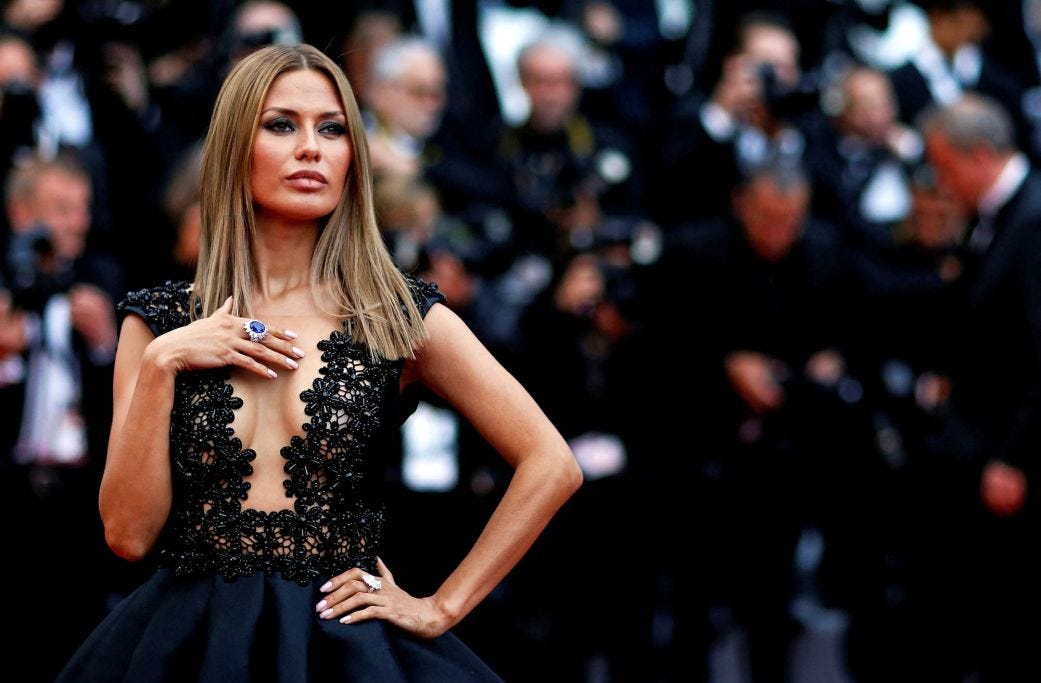
Prominent actress and beauty blogger Victoria Bonya, famous for starring in the early seasons of Russian reality TV show Dom-2 (2004–present), went viral after her ‘scathing’ appeal to President Putin.
During her 18-minute video, Bonya drew on pressing issues in the country, including the disastrous floods in Dagestan, livestock culls in Siberia, intensifying financial hardships for SMEs, and strict internet freedom limitations. The TV star presented herself as the defendant of the grievances of ordinary Russians.
However, the blogger trotted carefully, outlining issues that avoided perturbing authorities and challenging Putin’s authoritarian rule over the country. In the most daring part of the video, Victoria alleged that the Russian people—including regional governors—feared the President, and were too afraid to relay the gravity of the situation.
The scale of this response quickly attracted attention both inside and outside Russia, after the video garnered over 27 million views. Western media outlets took up the uproar to portray Bonya as an influential figure opposing the Russian authorities, with a publication from The Guardian citing her ‘scathing remarks’ and ‘fierce critique’ of the Kremlin.
In addition, a series of interview requests from Russian opposition outlets such as Silver Rain and Meduza followed. Bonya hit back vehemently, claiming that she “loved [her] country” and “loved [her] President,” shutting down suspicions of her membership in Russian opposition. Insisting that the media was misrepresenting her messaging, the TV star urged journalists to refrain from considering herself their ideological ally.
“I am not with you,” she remarked after facing considerable backlash from pro-Russian public figures, notably state-channel media figure Vladimir Solovyev. “Please do not associate me with [your] opposition.”
Abbas Gallyamov—a Russian exile and former speechwriter for President Vladimir Putin—analyses the effect of Bonya’s address on drawing in a ‘new audience’ into the realm of political dialogue. The unlikely participation of otherwise apolitical citizens poses the wider question about a more covertly dissenting form of civic dialogue in Russia, dissimilar to conventional state-society dialogue in Western democracies.
The success of Bonya’s video raises broader questions about who is capable of articulating public grievances in contemporary Russia, and through what channels such grievances are expressed.
On the basis of the social grievances that Bonya raised, the resonance that the public found with the blogger triggered an explosion of support, the strength of which surpassed the dwindling opposition outlets, many of which operate in exile. This is particularly striking given Bonya’s lack of political credentials and her repeated rejection of an oppositional identity.
Rather than emerging through familiar opposition structures, this resonance suggests that expressions of public grievance may increasingly be articulated through less conventional or institutional actors, particularly in times of heightened repression.
While more conspicuous forms of civic engagement, including direct manifestations of dissent, may be more readily understood by a Western political framework, the ordinary Russian may voice political concerns differently. What, then, is the Russian understanding of personal freedoms? Of justice? And of participation in dissenting rhetoric?
Bonya’s fierce appeal yet loyal position undermines long-standing Western assumptions about Russian dissent and the figures typically associated with it. Movements and campaigns by figures such as Navalny and Nemtsov have long been tokenised as representatives of Russia’s liberal opposition. While their appeal undeniably piqued support from certain groups in Russia in the past, the present domestic situation may point towards a more complicated reality.
Notably, the popularity of the blogger’s video is difficult to compare with the recent acclaim received by conventional pillars of the Russian opposition, such as Yulia Navalnaya’s continuation of Navalny’s project FBK (Anti-Corruption Foundation).
Viewed through this lens, the acclaim received by Bonya’s video is particularly revealing of political participation in Russia, especially the public’s aversion to explicit political agendas and reluctance to disrupt the status quo.
With the war’s further penetration into daily life, the lifestyle blogger found resonance through a form of civil society activity that does not fundamentally undermine the ruling party and carefully circumvents outright rejection of the governing system. Bonya’s conscious avoidance of blaming public grievances directly on the President is not only a strategic move familiar within the Kremlin’s political playbook, but simultaneously a key factor behind her broader appeal.
By refusing to align herself with any explicit ideology, or to place herself in stark opposition to the President, Bonya’s video enabled ordinary Russians to feel vindicated in their grievances without identifying themselves with overt political dissent or committing to a long-term political agenda. Her appeal did not fundamentally challenge the stability of the existing political order, nor did it implicate viewers in the risks that often accompany direct criticism of the authorities. Instead, it removed many of the social and political costs typically associated with participation in oppositional discourse.
Such a form of civic engagement is compatible with the wider public’s aversion to overt manifestations of dissent, which are frequently associated with instability, social upheaval and the disruptive nature of protest movements. By insisting on greater freedoms without the obligations or consequences of opposition membership, Bonya’s address helped lower the barriers that often discourage political participation among ordinary Russians.
Political science research delineates a similar narrative. Influential works on civil society in Russia insist that, rather than rendering the concept obsolete in the current political context, Russia’s state-society contention has long pursued a more nuanced form of dissent. As scholars argue, civil society in Russia should not be understood solely through the Western prism of binaries, such as the presence or absence of liberal democratic institutions or outward manifestations of opposition, but through the diverse ways citizens negotiate, challenge and engage with state power outside conventional frameworks of political participation.
Far from demonstrating total political apathy, the popularity of Bonya’s address suggests that civic engagement in contemporary Russia may be most effective when it allows citizens to express discontent without assuming the social and political risks associated with organised opposition, and when grievances are voiced in a manner that is not fundamentally disruptive to the familiar status quo.
While Russian understandings of liberal freedoms may appear contrarian and differ significantly from those of the West, episodic flare-ups such as the appeal of Bonya’s video serve as a reminder that political disengagement should not be confused with political indifference. The resonance of her message suggests that many Russians remain acutely aware of the social and economic pressures shaping their daily lives. What is often absent is not dissatisfaction itself, but a compelling vehicle through which that dissatisfaction can be expressed. In turn, Bonya’s address may reveal the blueprint for the conditions under which Russian civic consciousness is willing to make itself heard.
