


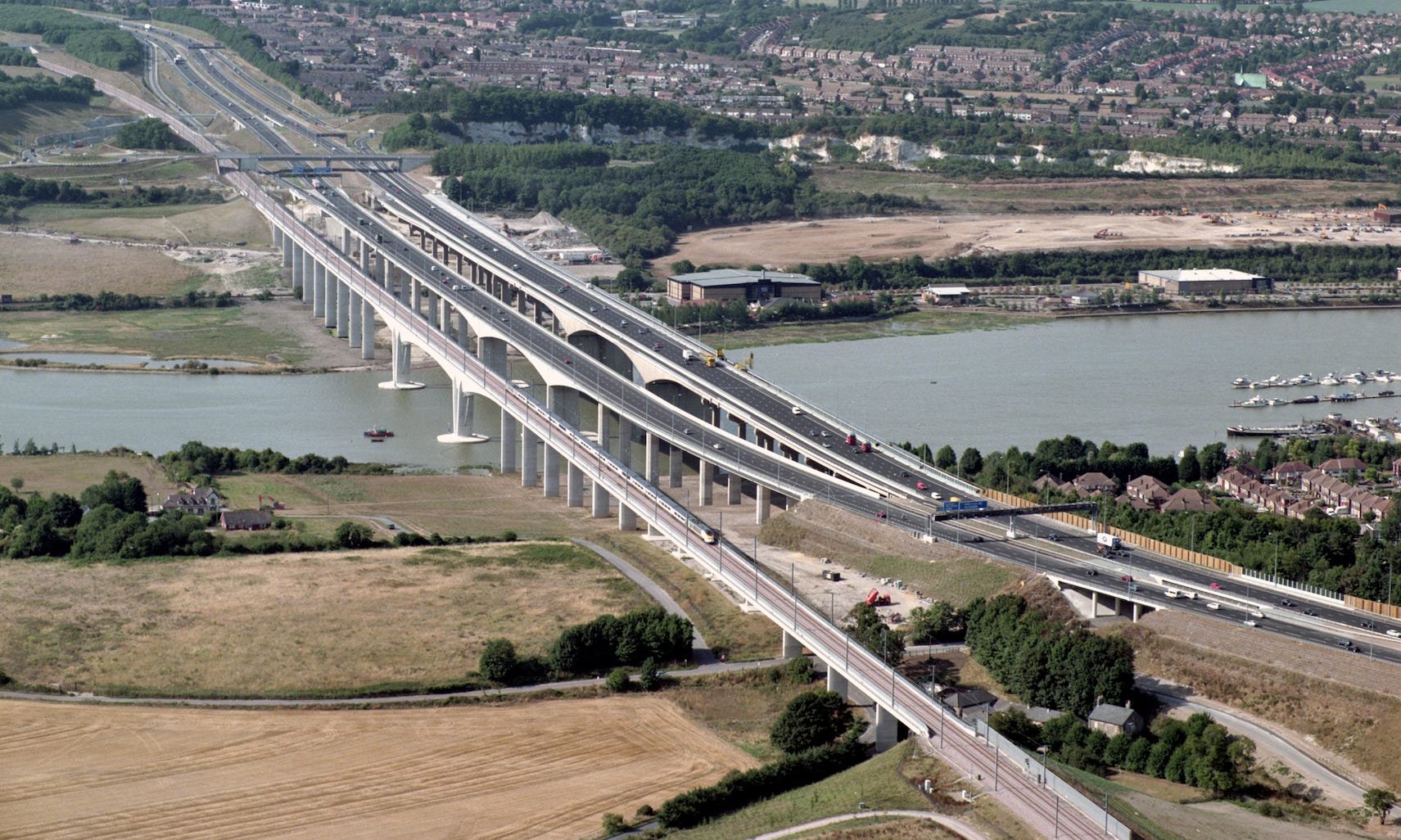
In May, the Labour government confirmed that HS2 will run at 320 km/h rather than the 360 km/h originally specified. When the cut was first reported in March, the Daily Mail’s verdict was that Britain’s flagship railway might now be “potentially... slower than in developing countries like India, Morocco and Indonesia.” Underneath the negative reactions was an assumption that is wrong twice over: that HS2 has been turned into an embarrassing, budget version of Britain’s high-speed ambitions, and that the same is true of the proposed HS2 Lite further north.
It helps to start with the original 360 km/h specification. The 2013 business case for HS2 promised the “best and fastest railway in the world”.
Not the most useful. Not the best value. The fastest.
And that is before considering that HS2’s main purpose was capacity relief in the first place. Speed mattered. But it was supposed to serve the railway’s wider purpose — capacity, connectivity and economic growth — rather than become an end in itself.
James Stewart’s 2025 review, commissioned by the government to investigate HS2’s cost overruns, traced part of the problem to “gold-plating”: building to unnecessarily demanding standards rather than asking what the railway actually needed to do. Lovegrove’s subsequent review of the Civil Service’s role in HS2 lists gold-plating among the programme’s “original sins”.
And gold-plating was hardly HS2’s only problem. The programme suffered from changing objectives, inefficient contracting, poor cost estimates, weak risk management and a failure to understand how much work was being handed to contractors before designs were sufficiently developed. Costs were repeatedly underestimated, while the programme became increasingly complex and difficult to manage.
The obsession with speed was not cost-free. HS2 was designed with exceptionally generous curve radii for unrestricted high-speed running, alongside demanding specifications for track, power, junctions and other infrastructure. Oakervee found that the trains themselves were not the main problem: manufacturers told the review that speeds would need to fall to around 250 km/h before rolling-stock costs became meaningfully cheaper. The bigger costs came from the infrastructure associated with a speed that was exceptionally ambitious, but offered limited practical value.
And yet Oakervee found little evidence that the programme had regularly stopped to ask whether these standards were actually worth what they cost. Britain fixed the ambition first and spent the next decade trying to justify it.
So what happens when you remove the obsession with speed?
HS2 runs at 320 km/h.
That is not slow.
320 km/h is the top operating speed of France’s TGV and Japan’s fastest Shinkansen services. HS1, which already carries Eurostar trains out of London on HS1, tops out at 300 km/h. China and Indonesia have services capable of 350 km/h, but 320 km/h is hardly some embarrassing second tier of high-speed rail. Nobody calls the TGV “TGV Lite”.
More importantly, the government has not suddenly rebuilt HS2 as a cheaper railway. The alignment remains the same, and the infrastructure has largely been designed around the costly higher speed anyway. The government's initial assessment says the principal savings come from avoiding the risks and costs of certifying the railway for a speed not currently operated anywhere in the world, alongside reduced testing and commissioning requirements.
The government estimates the change could save between £1 billion and £2.5 billion, while adding about three minutes to the London–Birmingham journey.
Three minutes.
That is not Britain abandoning high-speed rail. It is Britain finally asking whether 360 km/h was worth paying for.
Now apply the same question before the concrete is poured rather than after, and you get the proposal commonly labelled “HS2 Lite”.
After Rishi Sunak cancelled HS2 north of Birmingham in 2023, Andy Burnham, then Mayor of Greater Manchester, joined the West Midlands in commissioning a study, chaired by former Network Rail chief Sir David Higgins and led by Arup into a cheaper Birmingham–Manchester connection. Burnham is now Prime Minister, and his government has set a long-term objective to build a "lite" line between the two cities.
Except: Lite compared with what?
The Birmingham–Manchester leg of HS2 does not exist. There is no railway being downgraded, no 360 km/h service being replaced and no half-built line being stripped back. The Higgins–Arup proposal is therefore not a scaled-back version of a railway Britain had already committed to build. It is a proposal for a railway Britain has yet to decide how to build.
And it is deliberately less extravagant. The proposal envisages trains running at around 300 km/h and looks for savings through simpler infrastructure and greater use of land and assets already acquired for HS2. Its proponents estimate that it could cost up to 40 per cent less than the original Birmingham–Manchester leg.
The obvious response is that this must mean the north is getting less, but a cancelled railway is a strange benchmark for judging what Britain should build next. HS2 Lite is better understood not as a downgrade, but as a proposal that tries to learn from HS2’s mistakes.
That is why the language matters. Calling it “Lite” makes the original scheme the default and everything cheaper a compromise. But the original scheme is not the thing being delivered.
Iain Docherty and Jon Shaw have made a similar point about British infrastructure more broadly: things treated as fairly ordinary infrastructure elsewhere are often presented in Britain as “world class”, with the label becoming an excuse for greater complexity and cost. Look at high-speed rail elsewhere in Europe. Italy built the Bologna–Florence high-speed line through the Apennines, with around 94 per cent of the route in tunnels. They built difficult railways because they wanted railways.
Britain somehow ended up wanting the fastest railway in the world as well.
There is an obvious political incentive here. “We are building the fastest railway in the world” is a good headline. “We have specified this railway to the level actually required” is not.
One sounds ambitious, the other sounds competent.
That helps explain how 360 km/h survived for so long, and why 320 km/h is now being presented by some critics as a national embarrassment. It also explains why “HS2 Lite” sounds like a consolation prize when there is no original northern railway to be consoled for losing.
The problem with HS2 was never that Britain tried to build high-speed rail. It was that it repeatedly confused the most extravagant possible specification with the best possible railway.
320 km/h is not a failed 360 km/h railway.
A £1–2.5 billion saving is not evidence that Britain has given up.
And a Birmingham–Manchester railway designed at 300 km/h for substantially less than the cancelled scheme is not “HS2 Lite” simply because the number on its specification sheet is smaller.
The only embarrassment of the whole ordeal is that it took Britain thirteen years, multiple reviews and one cancelled phase to discover that “fastest” and “best” are not the same thing.

Great article. And to think Britain could have bought something similar off the shelf at much less cost!! Brings back horrific memories of the ATP (Advanced Passenger Train) that Britain tried to build in the 70’s and 80’s that “leaned” round corners at high speed on existing track - another disaster that never came to anything. We’ve been trying to build a high speed railway for nearly 50 years without success - and Britain invented the railway in the early 1800’s!!