


TW: discussion of sexual assault and violence; involvement of drugs
The traditional ideal of higher education was that of the site of intellectual, and ethical and social, christening. Venerated have been the co-constitutive processes of academic enlightenment and maturation, critical thought and scholarship intertwined with discovering how to live in community. In the 21st century, the relationship between the economic function of the degree and studying at an institution have been made more explicit in the public consciousness. We have been taught to lessen an idealistic association, and instead embrace its value as an investment for our future economic position. Students are encouraged (I would say increasingly pressured into prioritizing) to accumulate credentials, networks, professional experiences, and forms of cultural capital that can be converted into advantageous positions and marketability in the competitive labor market. A diploma is a costly and corporatized, no longer public good, and commodified, not issued from an independent institution but a purchasable means to an end. Although when we apply in our senior year of high school, we may daydream images of ivy-covered walls and libraries groaning under the weight of decadent anthologies, four years later, it is the italicization of the university’s name on our CV that replace them.
Furthermore, the neoliberal university participates in the production and reproduction of class position through credentialization and differentially allocating access to professional opportunities. This reproduction operates one, through students’ subsequent insertion into the labor market, and two, within the walls of the university itself as an institution, concerned with its relationships with (current and future) wealthy alumni, donors, employers, and political and professional elites.
The university is a site of privilege in two ways: a site of class reproduction, that is likewise structured by relational power, organized by gender, race, and other axes. As such, institutional priorities are formulated based on this matrix, dictating whose interests are protected and whose futures are deemed most socially and economically valuable. Some students and staff will be worth more in its eyes. We are speaking of the prime revenue-generating bunch, such as grant-earning tenured professors or superstar athletes, whose economic success is bound up with the university’s, as well as those poised to be the future donors and framed alumni. Amongst them are often the kings of college, the golden boys branded by gilded Greek letters: fraternity brothers.
Sororities and fraternities screen and admit members through processes that evaluate a pledging student’s full package. They consider how they look, their class background, their sexuality (but not necessarily the sexual reputation of brothers… ‘slut shaming’ is to be reserved for sisters!), what they can offer in terms of DEI, and their cultural capital, all together cultivating, through specific curation, and institutionalizing a structural, norm-ordained pipeline of social and economic mobility. By controlling the campus’s social infrastructure, including party locations, alcohol distribution, entry, and social themes (such as the only two ones I’ve heard of, which degradingly and, with truly astonishing unoriginality, are entitled Golf Pros and Tennis Hoes and CEOs and Office Hoes... wow, what else can we find that rhymes with ‘hoes’?), their plebeian subjects and maidens are theirs to command and will.
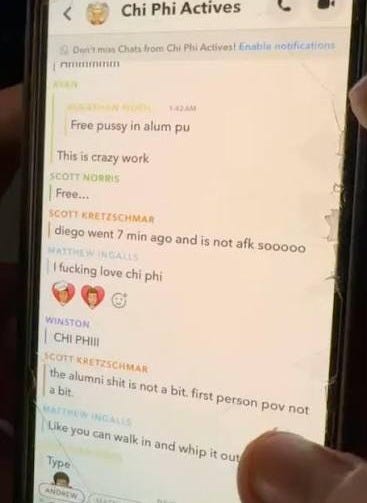
It is under these institutionalized conditions that the future of seven male Chi Phi students – Matthew Ingalls, Scott Norris, Winston Lee, Gillio Lopes, Jonathan Newell, Diego Sarabia, and Scott Kretzschmar, who wanted “free pussy” – and the appearance and financial stakes of the university were calculated to be more valuable than the human dignity of a female student, a survivor of drugged, multi-partnered, multi-rounded rape, and her future.
The legal trajectory of the Cornell Seven case is as follows. Jane Doe filed a lawsuit against Cornell, the fraternity Chi Phi, the seven men, and other defendants on September 16, 2026, reopening the case from November 2024. In this lawsuit, Doe alleges that she was pressured, being also underage, to consume drugs (ketamine, marijuana, and alcohol) and was subsequently sexually assaulted by multiple men over several hours, nearly two years ago. She originally reported the incident to Cornell Police on November 8 that year. Following this year’s lawsuit, the Tompkins County District Attorney reopened said former criminal investigation September 27/28. After internal Cornell proceedings of 2024, Doe’s attorney told CBS that only two accused students were expelled. Current information provided by Cornell leads us to believe that for the rest, two were briefly suspended, one had already graduated before any sanctions could be imposed, and the final two found not responsible for any sexual misconduct. Thus the university’s internal disciplinary process produced a set of what it deemed to be some appropriate sanctions. In the lawsuit, the allegation states that students involved were offered by Cornell the opportunity to write essays to receive lesser sanctions. Meanwhile, in 2024 the criminal investigation resulted in no charges being filled. Additionally, the two systems appear to have been operating with materially different information. Cornell says it provided the DA will all necessary investigatory material (including the Snapchat group chat screenshot), while the DA said his office never received the screenshot and had not seen the transcript of Doe’s interview to campus police where she stated she was confident she was raped. Doe’s lawyer has also revealed that Doe dropped out of Cornell after the events described in the complaint.
It is also worth mentioning that Cornell has (unlike three of the Cornell Seven who went unscathed) allegedly expelled, and documentededly suspended and banned students involved in pro-Palestine protests against the ongoing genocide in Gaza, including bans from campus for three years (in comparison with the mere two-semester suspension sanctioned on two of the Cornell Seven). It also failed, a year after, to protect a student’s immigration status after his student visa was revoked due to his participation in pro-Palestine protests. As the university initially moved toward disenrolling him, he chose to leave the United States voluntarily, after ICE asked him to surrender and a judge declined to immediately block the government from deportation proceedings. We might want to raise questions about what kind of conduct the university is keenly interested in punishing.1
The subsequent paragraphs will summarize and recount Jane Doe’s 2026 civil lawsuit statement, the allegations, and purely pulls from such (i.e.: this is not the same material handled in 2024). I urge you to please, take a moment and reflect whether, in reiteration of the trigger warning, you decide to proceed with reading it. I have visually differentiated the following text to make it easier to skip.
On the evening of October 19, 2024, Jane Doe walked to Chi Phi to meet a friend, Male No. 1, whom she had arranged to see over text. Before arriving she had been at Tri Delta, then two bars, where she had consumed a large amount of alcohol over approximately three hours. Her sorority sisters took her to these bars despite her condition and that she was served alcohol while underage. She described herself at that point as around five out of ten intoxicated, opened a beer after arriving, and flirted with him. He proposed a threesome with him and Male No. 2. She was surprised. She agreed and they had oral and vaginal sex, which she initially described as something she was “pretty okay with,” but she asked Male No. 2 to stop when Male No. 1 became very sleepy. She wanted to make sure he was alright. While Male No. 1 slept and Male No. 2 began dry-heaving and became sick, Doe tended to them, only for Male No. 2 to resume making sexual advances on her. They briefly made out. He repeatedly reached for her vagina, and she repeatedly swatted his hand away. Male No. 3 then entered the room, pulled Doe toward him and kissed her, while Male No. 2 simultaneously groped her, after which the three had sex. When Male No. 1 awoke and proposed a foursome, Doe refused, saying “hell no” because she understood it would involve anal sex, and dove under the covers. She subsequently remembered additional men, later identified as Males No. 4 the way through 7, entering the room. Her memory became elusive and fragmented onwards. She vaguely recalled Male No. 7 making a crude and mean remark to her but not its particular articulation, apologizing, then him grabbing her face and kissing her, only for her to try to back away. Doe recalled that one of the men also slapped her hard enough to leave bruises.
Shortly thereafter, Male No. 2 offered her ketamine, pouring a line, of large quantity, onto his erect penis, implying that she should snort it. She did. He then got under the covers with her and again reached for her vagina. At this point, Doe was under the covers while Male No. 2 lay beside her, Male No. 1 sat at the corner of the bed, and the other men remained in the room. The men proceeded to compliment her appearance and ask whether they could do drugs off her “perfect body”, which she agreed to, before she became dizzy, a probable mix of the ketamine and a pre-existing health condition, and was taken upstairs by Male No. 1 and Male No. 4. She also stated that she was given marijuana and liquor throughout the night.
Before they took her upstairs, Male No. 3 and another man entered the room and said something to the effect of “we’re shutting down whatever the fuck this is.” She further alleges that Male No. 2 had sent a message to the “Chi Phi Actives” group chat with fifty additional members, fifty-seven fraternity brothers receiving the texts in total, advertising that there was a woman available for sex, after which additional men entered the room. Various of the fifty-seven men acknowledged the messages and some responded, which one of the men in the room re-iterated affirmatively that she was still there, prompting that they could join.
Male No. 1 offered her more ketamine, after which she became extremely high and he proposed having sex again, telling her he wanted “redemption” for having passed out earlier. Doe asked, “what happened to just you and me?”, but recalled another sexual encounter happening with Males No. 1 and 4, by which point she described herself as eight out of ten intoxicated. According to Doe’s recollection, the encounter continued until approximately 5:45 a.m., when she said she was tired and needed to sleep and, as far as she remembered, both men stopped.
According to the complaint, the entire episode lasted approximately seven hours and involved all seven men. It further alleges that Doe was left unconscious around 5:45 a.m. When she awoke later that morning and returned to her sorority house, she discovered bruising and other physical evidence that she associated with what had happened at Chi Phi. She subsequently began to try to reconstruct what had happened. She reported the incident to Cornell University Police on around November 8, 2024, during which she stated that she was “100% confident” that she had been raped.
Mainstream reporting stops at presenting the Cornell Seven as a case of institutional betrayal. However, it demandingly needs to be understood, is more critically characterized as a case of institutional protection.
When sexual violence occurs, the neoliberal university views the primary threat not the moral violation nor the physical harm endured by the student, but the potential public disclosure that could damage the university’s public image, enrollment rates, or revenues. Questions of justice are re-oriented into administrative assessments organized around market logics, whose consequences amount to a response that is undeniably dismaying and disillusioning, purposeful inaction. The mediated sanctions on perpetrators, those of not just legally reprehensible crimes, but cruel, immoral and inhumane acts against fellow students, are constitutively designed to be damage control, seldom systemic accountability or survivor restoration, and fail to bring about substantive justice. Rather than investigating claims transparently, administrative procedures are designed to de-escalate or compartmentalize reports to limit the legal exposure and financial risks. Questions of respecting privacy and institutional order are often invoked, using mechanisms such as confidential settlements, NDAs, and demure resignations that carefully sweep the matter under the rug, whilst high-reward PR statements are mobilized for image protection. Furthermore, the translation of a violent act into an administrative, organizational matter can make the underlying relations of power obscured from view, rationalizing and masking instances of financially-motivated cahoots and gendered violence.
These logics are also mirrored at the student organization level within fraternities’ disciplinary systems. They utilize their own internal self-pardoning judicial councils who secure their fellow kin’s impunity, protecting the fraternity’s reputation and brotherhood. Disciplinary mechanisms and, more broadly, fraternity culture revolve around internal codes of silence like ‘don’t fuck your brother’, such that when sanctions are issued, they are perfunctory, symbolic in purpose. A self-enforcing shield of protection is erected upon the pledge class, for when everyone participates or witnesses the act, there can only be mutual blackmail.
Hazing plays a crucial role in this resocialization of brothers, elite university fraternities functioning like a bacchanalian incubator for the Epstein class. Sorority rushing isn’t absolved either from what it inflicts on its sisters. There they learn how business is dealt with in the real world. Are taught that to secure power and privilege involves no longer seeing violence as violent: the banalization of suffering. Control looks like force and hurting others, enacted in the dark basement of the fraternity chapter house (often, uncannily, columned, white mansions), and that practice a ritualized, hierarchical legacy yours to inherit once you pay your dues. These young men are being primed for the system, to take on the work of their grandfathers and fathers.
If you are outraged by the actions of the Chi Phi brothers, you should likewise be outraged by the administration’s arbiters of justice, the Civil Rights Office, especially Lauren Branchini, the Title IX Coordinator, overseeing every single step of sexual misconduct legal processes. The Civil Rights Office of bureaucrats of ‘neutral’ interest obfuscate operations in favor of the university’s interests (and let me be explicit about what those interests are: those of assets, the university’s personal long term portfolio and financial relationships to donors which depend on a sanitized public and capitulating political image, and ensuring the secure trajectory of the alumni that will belong, and already do, to this very same elite class). These processes are purposefully complex for survivors to proceed with. Branchini’s conduct of them resulted in inconsistencies when comparing the evidentiary material collected with that of civil lawsuit. It is these very processes that yielded the aforementioned unsatisfactory sanctions, with Branchini’s signature at the bottom. I mourn for Doe, thinking about how it must have felt to know it was another woman that ultimately signed off on those papers.
Importantly, Greek life serves as an institutional and campus-cultural bridging between reproduction of power relations organized around class, sexuality, gender, and race. The normalization of ‘hook-up culture’ on campuses can be understood partly as compatible with the neoliberal professional development imperative. Sexual relationships can be engaged in whilst delaying longer-term and effort- and time-consuming commitments of romantic relationships, allowing students to prioritize credential accumulation and career preparation. Hook-up culture ultimately ends up representing an expansion of women’s sexual and economic autonomy to some extent, while simultaneously reproducing gender hierarchy within the new sexual order.
Campus hook-up culture (different from casual sex per se) is illusorily emancipatory for women. Normalizing sexual behavior outside of relationships separates sexuality from the long-term reproductive and relational obligations that historically constrained women’s participation in education and employment. Yet the sexual marketplace through which this freedom to hook-up is exercised is structured by gendered, heteronormative, classed, and racial inequalities, occurring in and organized through social media, dating apps, and, within the university, the Greek system and life. The sexual autonomy ostensibly offered by hook-up culture is therefore accompanied by a pervasive sexual double standard, where fraternity brothers exercise asymmetric control and can deploy coercive sexual strategies with structural legitimacy. Another consequence of hook-up culture is the disregard, devaluation, and marginalization of women’s feelings and personhood within the hook-up scene. The transactional nature of these interactions erodes mutual concern and respect and promotes men’s affective detachment. Moreover, men can engage more frequently in casual sex without losing social status, in fact, can accrue cultural capital for it, while women risk being labeled as ‘sluts’ and socially shamed for engaging in the same exact behavior. Women can therefore technically choose whether to participate in casual sexual relations through hook-up culture, but they do so under conditions that are not equal; their choices are structured by other structural social inequalities (for example, women of color demonstrated lower participation rates, namely on dating apps, by virtue of exclusion and opting out, and report uncomfortable experiences of hyper-sexualization, racialization, stereotyping, or being ignored), concerns of reputation, safety, and the unequal distribution of power over the spaces in which boozey sexual encounters and socializing occur. And said spaces, at many universities, are almost exclusively fraternity parties.
Intense alcohol consumption is also embedded within hook-up culture, lowering resistance to sexual interactions and offering perpetrators plausible deniability, the alibi of a mutual, drunkenly-brazen encounter rather than a non-consensual violation of body and personhood. Along sobriety or lack thereof, there exists a plethora of other rape myths at disposal to divert scrutiny from the perpetrator’s acts onto the survivor’s conduct, utilized by both the student body and administration. Focusing so much time on scrutinizing the survivor’s choices, subjecting them to intrusive and humiliating questioning regarding how much they drank, what they were wearing, or whether they were flirting and presenting it as questioning in good, egalitarian faith, is perversive and a form of secondary violence. And so is that little guileful comment, spoken in a feignedly reticent tone or the guise of being a faithful legalist: “But, I mean… maybe… did she…”
My point is of especial importance in light of discourse I can already see brewing under the surface. Prickly questions about what it means that Doe perhaps intended to hook-up with the first brother and continued to socialize with multiple after that night. The proceeding behavior of survivors should not have to conform to popular expectations of what assault looks like. Likewise, I think we can all bare-minimum conceive more appropriate, more ethical ways to approach consensual (and more contestedly, intoxicated) sex. Moreover, listen to loud resonating whispers of the words ‘I completely understand her’, ‘I see what she did in what I did’, and ‘I sustained a friendship with my assaulter for a while thereafter.’ Upon trauma, the brain doesn’t know what to do. It is trying to process something it should not have to process, cannot easily make sense of. But yes, how could the brother have brutally violated Doe for she iMessaged him that they should smoke together soon, “but like leave out the extra 5 billion men and ketamine”?
A powerful ideology shielding fraternity men is the framing of male misconduct as born out of immaturity and youthful impulse rather than accountable and consciously enacted harm. Popular culture and institutional norms love to depict fraternity misconduct as normal or juvenile, as something that should not impede on the brother’s rightful access to a successful professional future. When transgressions occur, institutional and campus discourses characterize perpetrators as impressionable and horny boys who merely made a mistake, who need to be taught better. Suddenly it becomes obvious how a speciously reformatory, pedagogical-focused policy of having to write a couple of essays, offered as a means of reducing sanctions, can be applied to perpetrators of something as abhorrent as rape, or fifty complicit fraternity brothers. Who watched over the string of messages, including the following three words, sent at 1:42 a.m., that are saturated with such depravity that I lurched my laptop shut when I read them: “Shop still open?”
So fraternity brothers, look at me, at us, and at Doe. Answer us when we ask: is this brotherhood? The monopoly over the social scene, internal codes of collective self-protection and exculpation, and the simultaneous infantilization and brutalization of its members, braced by the knowledge that survivors must entrust their cases to a system whose interests structurally oppose their own? Is brotherhood what made the fifty-seven brothers of Chi Phi feel safe, feel turned on, when they did what they did together?
Is brotherly power derived from being knowing insiders within a pack? Does it mean possession of a ticket for some perverted, carnivalesque exercise of gentlemen’s-club bonding? Is it the de-individualizing suspension of morality and culpability, where the virtue of loyalty means collusion? And to have been able to achieve physical closeness without violating the homophobic boundaries of masculinity, did it demand that the brothers use her body and that voyeuristic group chat as conduits? Must Doe be the sacrificed creature through which the cult can commune?
This condemnatory assessment of Greek life under the neoliberal, gendered university matters not only because it participates in the production of acts of abuse, violence, and discrimination broadly on campus, but because it significantly perpetrates the conditions needed under which campus sexual violence, like the Cornell Seven case, is dealt with. Dealt with in the appalling, seemingly anomalous, but in fact systemic way that it did. Every sort of power structure that functions such that harming other people acquires you more power will breed and nourish rape culture. I urge you to look closer at my words: it is a warning, an indictment of an interminable, waltz of reformism. Just two days after Tompkins County District Attorney said they would reopen the criminal investigation, the Trump administration rescinded Title IX Biden administration rewrites, making it harder to report sexual assault on campuses.
Discourse cannot frame sexual violence insularly as a private misunderstanding between two equally-situated individuals and most certainly not entertain ideas around rape being a consequence of the survivor’s imprudence. Nor can it stop at the recognition that these institutions have errantly failed to administer justice. It must, we must, whilst foremost centering concern and empathy for survivors as they encounter it and our critical efforts, interrogate the social genealogy of perpetration and critically examine rape culture, now and in our daily lives.
In suit, we must also invest equal energy in community-building outside of the institutions that fail us. We need more everyday acts of resistance, such as refusing to partake in and permit the continuation of the culture and traditions safeguarding perpetration and complicity. A greater task is to identify strategic entry points for contravening and rewriting them.
Because when someone makes a rape joke, it is that deep. So are the scoring systems ranking girls and their sexual performance, the spread of rumors and intimate images, or the charged themes of parties. Putting on pussy-cat ears can sometimes be playful, but what happens when that fantasy is no longer about you, the person, but about you the animal, put down on all fours, eye-level with his hips? Living in the chapter house can bring about life-long friendships, laughing with your neighboring brother about how loudly his bed creaked last night, but what happens when he pulls out his phone to show you the non-consensual recording he took of her and him?
For however long the duration for which the physical assault lasts, assault does not end there. Assault lasts a lifetime, is also the narratives and rumors that follow you. The stares from classmates, your heart-sinking when you find out that everyone has an opinion on your university’s anonymous campus social media app before you made the choice to share anything yet, to whom, or ever. Not to mention the other complex ways trauma lives in the body and mind.
The Cornell Seven are a media spectacle, which have and will elicit many differing reactions. There will be denial, rejection, anger, hurt… I’d like to raise attention to two.
One, the feeling of guilt from brothers. Guilt of complicity, perhaps knowing about instances similar in varying degrees alike to Does. In that same vein, I have heard some men say they are mad, I believe secondarily to reckon with that guilt. They say they want to beat up brothers like the Cornell Seven. To this I say, the violence you want to inflict on them is the other side of the coin of the violence towards women. It is a re-iteration of physical domination meaning power. What is a true demonstration of strength and courage is refusing complicity and having the conversations needed to halt instances of sexual violence from occurring. Conversation you may need to have with friends, and certainly, your brothers.
Secondly, and most importantly, the feeling of distress from the sisters of Jane Doe. Survivors. The media spectacle that has come of the Cornell Seven, is in some ways, many women’s story becoming sensationalized. I know I am participating in the circulation. That is why I want to end my essay by saying this. Jane Doe does not need our superficial outrage. She does not need instagram stories of catchy, vacuous 5-word slogans.2 Instead of reposts, what Doe deserves is the support and freedom to process the reporting however she needs to. However all survivors need to as they navigate reading the media coverage themselves. This is the most difficult form of solidarity to show. We are not good because we hate bad men. We are good because we make ourselves useful to those that have been harmed, as well as accountable. Vocal against the harm. Productive, awareness-arming, support, centering the dignity, care, and triumph of one another as survivors, supporters, friends, and family – as brothers and sisters – is of utmost value. Otherwise, these insidious, evasive verdicts will be all that is left, consolatory essay writing deemed appropriate for raping a girl for hours or smirking at the phone screen as it happens a couple floors up.
I would like to preemptively address the argument that this comparison cannot be made because it overly collapses the two cases, and in the same breath, acknowledge that they do not relate to the same Titles. Proceedings concerning sexual misconduct are dealt with under Title IX and Cornell’s sexual-misconduct procedures, whereas pro-Palestine protesting implicates Title VI’ s protections against discrimination based on race, color, or national origin, and may involve the First Amendment and academic-freedom rights. The comparison is not to suggest that underlying conduct is equivalent or that we can entirely neutralize them for the sake of comparison, but to bring to light parallel exercises of disciplinary authority by Cornell, by that I mean exercises within the same broad timeline, under the same political climate, with markedly different institutional consequences.
This practice often falls short of being effective because the point becomes performance of asserted beliefs. Genuine belief-holding is superseded by virtue-signaling, financially incentivized when it increases profile engagement. As a trend, it allows people to assume something about your morality. Furthermore, if the extent of your actions stops at reposts and political identity peacocking, does not translate into any material avenues in your life, you are depoliticizing those slogans, which is harmful.
