


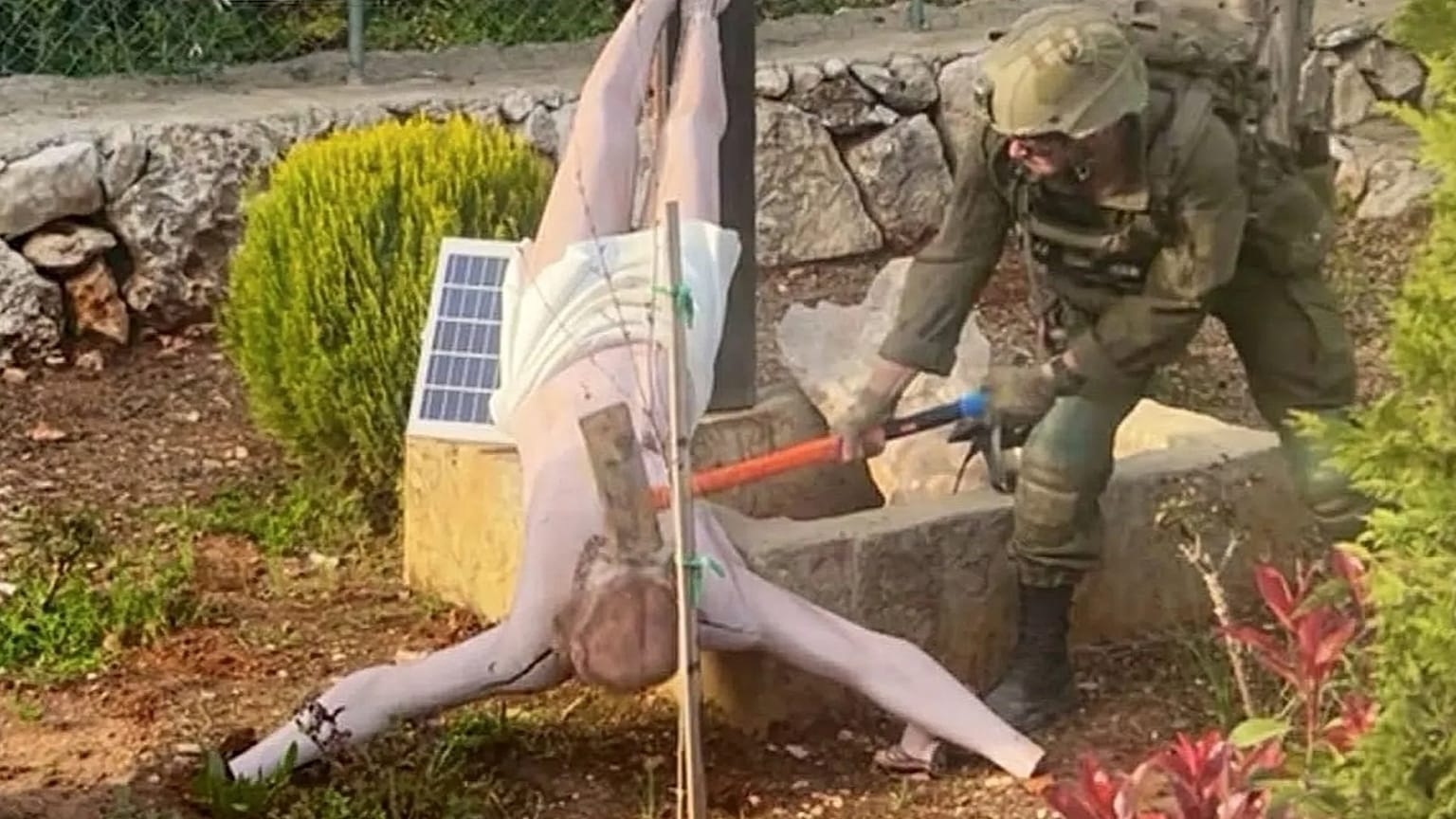
There is a photograph circulating online this week, taken in the Lebanese village of Debel.
In it, a soldier — IDF uniform, unmistakable — holds a hammer above a statue of Jesus Christ. The figure has been pulled from its cross and turned upside down. The soldier’s expression is blank. He could be fixing a shelf.
The IDF confirmed the photograph was genuine and vowed disciplinary action. Israeli Prime Minister Benjamin Netanyahu said he was “stunned and saddened,” denouncing the act “in the strongest terms.” The condemnations were swift, the outrage international.
Then the news cycle moved on. But for the Christians of Gaza, Lebanon, and Jerusalem, it has not.
Gaza:
Only around 1,100 Christians live in Gaza, according to a 2024 US State Department report, down from 3,000 in 2007. They are, by any measure, a community on the edge of extinction.
On 19 October 2023, an Israeli airstrike struck a building within the compound of the Church of Saint Porphyrius — one of the oldest churches in the world — where some 500 civilians, mostly Christians, had taken shelter. At least 17 were killed. The Greek Orthodox Patriarchate denounced it as a war crime, while Amnesty International called for an investigation.
Then, in July 2025, a deadly strike hit the Holy Family Church, Gaza’s only Catholic church. Three people were killed: Najwa Abu Dawood, Foumia Issa Latif Ayyad, and Saad Issa Kostandi Salameh. The church’s priest, Father Gabriel Romanelli — an Argentine who has ministered in Gaza for nearly three decades — was also wounded. The IDF attributed the strike to a misfired munition. The Israeli government said it deeply regretted the incident.
One church bombed. One church struck by tank fire. All within a congregation of barely one thousand.
Lebanon:
On the afternoon of 9 March 2026, a fifty-year-old Maronite Catholic priest was struck by tank fire in the village of Qlayaa while running toward the wounded to help them.
His name was Father Pierre al-Rahi. In Arabic, al-Rahi means the shepherd.
Father Pierre had defied an Israeli evacuation order to stay with his parishioners. Three days before his death, he had delivered a speech from the steps of a church:
“None of us carries weapons. The only weapons we carry are peace, love, and prayer.”
An Israeli tank fired on a house in the village. Neighbours, Red Cross workers, and Father Pierre rushed to help. Then the tank fired a second time, injuring Father Pierre. He died before reaching the hospital.
The destruction of the Jesus statue in Debel came weeks later. By then, Father Pierre al-Rahi had been largely forgotten by the same news cycle that made the statue go viral.
The 2026 war has killed 2,000 Lebanese and displaced more than 1 Million, including many Christians. Southern Lebanon’s Christian communities — historically neutral, unarmed, and vocally opposed to Hezbollah — have watched their villages obliterated. In April 2026, an IDF strike on a church-sponsored social housing complex in Ain Saade, a Christian locality near Beirut, killed at least three people: including local politician Pierre Moawad of the Lebanese Forces, a party fiercely opposed to Hezbollah.
Jerusalem:
Israel presents itself, consistently, as the Middle East’s sole guarantor of religious freedom. That claim became very difficult to defend on Palm Sunday this year.
For the first time in centuries, the heads of the Church were prevented from celebrating Palm Sunday Mass at the Church of the Holy Sepulchre — the holiest site in Christianity. Israeli police, citing security concerns, stopped Cardinal Pierbattista Pizzaballa, the Latin Patriarch of Jerusalem, from entering — despite having requested permission for a private celebration for a few religious leaders.
But Palm Sunday was not an aberration.
Bishop Emeritus Munib Younan describes being spat at “many times” by Jewish yeshiva students in the Old City without any legal repercussions. Boulos, a Christian shopkeeper in the Quarter, now travels to Bethlehem to attend church:
“There, nobody is pointing a gun at you on the way to church. Life is at least normal. Here, life is not.”
Many young Palestinian Christians are now actively seeking to emigrate. The community has already dwindled to less than 2 percent of the population. Each departure is felt. Few return.
Inheritance Without Solidarity
There is a specific irony that goes largely unspoken.
The countries most visibly underwriting this war are heirs to a civilisation that defined itself, for centuries, as Christian. Since October 2023, the United States alone has provided at least $16.3 billion in direct military aid to Israel. Britain, France, and Germany have given diplomatic cover and arms of their own.
These are largely secular societies now. Scholars distinguish between confessional Christianity — active belief and worship, which has declined sharply — and heritage Christianity, treating faith as a source of cultural identity and history, which has not. It is the latter that most Western governments represent: nations that have shed the practice but kept the civilisational claim.
Yet as Gaza’s last Catholic church is struck by tank fire, as a Maronite priest dies running toward the wounded, and the Church of the Holy Sepulchre is locked on Palm Sunday — Washington’s response was to “raise concerns.”
The Christians of the Levant are asking not to be forgotten by the civilisation that was, not so long ago, defined by the same cross now being smashed with a hammer in southern Lebanon.
A Pattern, Not a Policy
It would be dishonest to argue that Israel is conducting a deliberate campaign against Christians. The IDF condemns individual acts of desecration when they surface. Netanyahu issues statements. Investigations are opened.
Yet condemnations are not consequences, and statements are not accountability.
What is undeniable is the pattern: churches struck in Gaza, a priest killed in Lebanon, a mock wedding staged by soldiers inside an Orthodox church in Deir Mimas, a Jesus statue smashed and posted online, the holiest site in Christendom locked on the holiest day of the Christian year.
These are not accidents connected only by coincidence.
Even Israeli commentators have noted the deeper issue. Writing in the Times of Israel, Lazar Berman observed that the IDF has not put an end to the phenomenon of soldiers filming themselves defying regulations and international law, and uploading that content to the internet — despite the incalculable damage this does to the legitimacy of Israel’s military operations. This is not a rogue soldier problem.
The Christians of this region — Palestinian, Lebanese, Israeli — are an ancient community caught between a state that claims to protect them and wars that keep killing them. They are declining in number everywhere they exist in the Holy Land.
And the world is watching it happen.
